AI-Driven Barcode & RFID Recognition: Elevating Retail and Warehouse Inventory Efficiency

0 comments

For decades, barcode scanning and RFID identification have served as the core data capture technologies for retail and warehouse inventory management. From goods receiving and shelf restocking to cycle counting and outbound verification, frontline teams rely on these tools to maintain accurate digital inventory records. However, complex on-site environments always hinder traditional identification efficiency. Glossy packaging reflection, smudged and damaged labels, dim lighting, dust and overlapping stickers all lead to low recognition rates, repeated rescanning and manual input errors.

Traditional single-mode scanning equipment can no longer adapt to the diversified inventory needs of modern supply chains. The integration of artificial intelligence, edge computing and multi-sensor fusion has completely upgraded barcode, RFID and visual recognition technologies, greatly improving identification stability in harsh scenarios and realizing efficient, accurate and intelligent AI inventory management for retail and warehousing. This blog explores the value of AI intelligent recognition technology in inventory scenarios and recommends a professional industrial handheld terminal for on-site deployment.

1. Core Pain Points of Traditional Inventory Recognition

Legacy barcode scanners and RFID readers are designed for ideal laboratory environments, and their inherent limitations are fully exposed in actual store and warehouse operations, bringing persistent efficiency and accuracy bottlenecks to inventory work.
First, poor adaptability to complex environments. Traditional fixed-algorithm scanners can only identify clear and complete labels. Once labels are scratched, faded, stained or covered by reflective packaging, the first-pass recognition rate drops sharply. Operators spend a lot of time adjusting scanning angles, cleaning labels and manually entering SKU codes, seriously reducing operational efficiency.

Second, high labor cost and low inventory efficiency. Traditional inventory relies on one-by-one manual scanning. Full stocktaking of large warehouses and chain retail stores takes a long time, and most inventory work can only be carried out after business hours. Discrepancies between physical inventory and system data are common, resulting in out-of-stock losses, overstock capital occupation and inventory shrinkage.

Third, isolated multi-technology workflows. Most enterprises use both barcodes and RFID tags for inventory management, but traditional devices separate barcode scanning and RFID reading. Staff need to switch between multiple devices frequently, with cumbersome operation steps and scattered data, which is easy to cause data mismatch and increase subsequent sorting costs.

Fourth, weak anti-interference ability. Warehouse metal shelves, cold chain condensation, uneven lighting and other complex environments will interfere with RFID radio frequency signals and barcode visual recognition, leading to missing and wrong readings, and further reducing inventory data accuracy.

2. AI Technology Empowers New Upgrades of Intelligent Recognition

Different from the superficial AI embellishment of traditional equipment, the new generation of AI-driven recognition technology reconstructs the underlying decoding logic through deep learning models and edge local inference, realizing comprehensive breakthroughs in environmental adaptability, recognition accuracy and scenario compatibility, and solving the pain points of traditional inventory recognition in one fell swoop.

2.1 AI Optimizes Barcode Visual Decoding

AI intelligent scanners are trained on massive real-world imperfect barcode datasets, covering reflection, smudge, scratch, fading, distortion and other defective label scenarios. Different from traditional fixed image processing filters, edge AI algorithms can intelligently suppress environmental noise, compensate for light and distortion, extract effective barcode feature fragments and reconstruct identifiable data information.
This technology realizes stable recognition in harsh environments such as strong light reflection, dark shadows and label damage, greatly improving the first-pass reading rate. It eliminates repeated rescanning and manual input, and effectively improves the efficiency of frontline scanning and collection work.

2.2 Multi-Sensor Fusion Breaks Technical Barriers

Barcodes have accurate item identification capabilities but rely on line-of-sight scanning; RFID supports batch non-line-of-sight reading but is susceptible to metal and environmental interference. AI sensor fusion technology organically integrates barcode vision, RFID radio frequency and computer vision to realize complementary advantages of multiple technologies.
The device can complete barcode decoding, batch RFID tag reading and visual scene collection in a single operation. The AI system automatically filters RFID interference noise, cross-verifies barcode and tag data, and marks abnormal data for manual review. When a single technology fails to identify, other modes can automatically take over, completely eliminating inventory identification blind spots.

2.3 Realize Large-Scale AI Intelligent Inventory

With the maturity of edge AI deployment, intelligent inventory has moved from conceptual verification to large-scale commercial landing in retail and warehousing scenarios. For retail stores, staff can complete shelf inventory through multi-mode intelligent terminals during business hours, realizing real-time monitoring of out-of-stock, misplaced goods and inventory shrinkage, and avoiding after-hours overtime stocktaking.
For distribution warehouses, AI equipment efficiently completes goods receiving, cycle counting and outbound inspection. It supports mixed identification of barcode-only goods and RFID-tagged goods, realizes continuous inventory inspection without stopping work, greatly shortens the inventory cycle, and fundamentally improves the timeliness and accuracy of inventory data.

3. Practical Business Value of AI Intelligent Inventory

The application of AI-driven barcode and RFID recognition technology brings measurable operational improvements and economic benefits to retail and warehouse enterprises, covering efficiency, cost, accuracy and management dimensions.
First, improve on-site recognition stability. AI algorithm optimization greatly enhances the environmental adaptability of identification equipment, effectively coping with label damage, light changes and environmental interference, and maintaining a high reading rate in complex working conditions.
Second, reduce labor time and cost. The integrated multi-mode operation and efficient recognition capability greatly shorten the inventory cycle, reduce repetitive and tedious manual operations, and free frontline labor for high-value work such as customer service and order processing.
Third, realize precise inventory management. Multi-data cross-verification eliminates manual errors and single-technology identification loopholes, realizes real-time synchronization of physical inventory and system data, reduces phantom inventory, and avoids sales losses and capital waste caused by inventory discrepancies.
Fourth, simplify equipment operation and maintenance. Integrated multi-mode intelligent terminals replace multiple independent scanning and reading devices, simplifying equipment procurement, staff training and daily maintenance, and reducing enterprise operation and management costs.
Fifth, support iterative upgrading of capabilities. Edge AI models support over-the-air remote updates, which can continuously optimize recognition algorithms according to new packaging forms and environmental changes without replacing hardware, ensuring the long-term applicability of equipment.

4. Selection Standards for Industrial-Grade Intelligent Inventory Terminals

To give full play to the advantages of AI intelligent recognition technology, enterprises need to match professional and reliable industrial hardware. When selecting inventory terminals, the core performance indicators should be focused on:
Multi-mode integrated capability: Integrate AI barcode decoding and high-performance UHF RFID reading to support one-step mixed identification of different goods.
Harsh environment adaptability: Industrial rugged design with dustproof, drop-proof and waterproof performance, adapting to complex warehouse and store back-end working environments.
Stable edge AI performance: Equipped with high-performance processor to ensure smooth local algorithm operation and no lag in identification and data processing.
Strong anti-interference ability: Optimized RFID antenna design to resist metal shelf interference and ensure stable batch reading performance.
Full-scene connectivity: Support Wi-Fi 6, 4G, Bluetooth and other multi-channel connections, with offline caching function to ensure uninterrupted data collection.
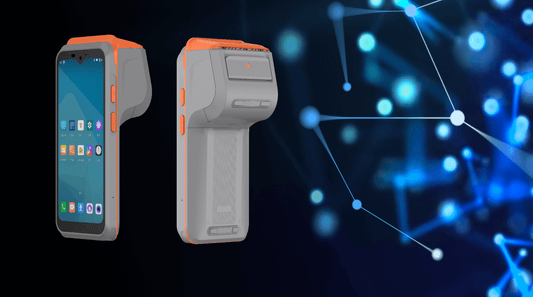
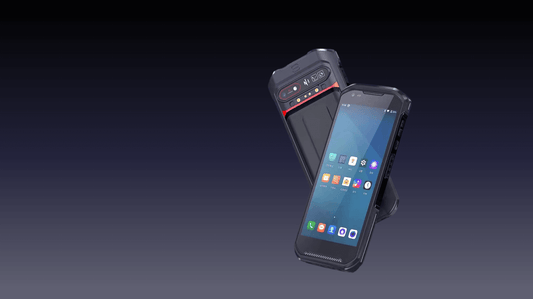
For retail shelf audits, warehouse goods receiving, cycle counting and asset tracking scenarios, the LS-HC720S integrates dual functions of AI barcode vision and RFID reading, replacing multiple traditional devices. It is a cost-effective and high-performance core hardware for enterprises to upgrade AI intelligent inventory systems.
industry mobile computer with pistol grip LS-C720S

6. Conclusion

AI‑powered barcode, RFID and computer‑vision recognition is reshaping retail and warehouse inventory management. Instead of being limited by clean‑label laboratory conditions, modern edge‑AI technology significantly lifts identification reliability in real‑world problematic scenarios with glare, smudges and label damage. Multi‑sensor fusion breaks down traditional barriers between barcode and RFID workflows, making scalable AI‑assisted inventory counting commercially viable.

This transformation is not about fully replacing human workers with autonomous robots. It is about equipping front‑line staff with smarter tools that eliminate tedious workflow frictions, reduce manual entry errors and deliver more accurate real‑time inventory visibility. Businesses gain clearer stock insights, lower operational costs and fewer lost‑sale risks caused by inventory mismatches.

Nonetheless, technology performance depends heavily on well‑selected hardware matching actual site conditions. Integrated multi‑mode rugged handheld terminals such as LS‑HC720S bridge AI algorithm innovation and practical on‑site requirements, offering a practical path for enterprises to step into AI‑driven inventory operations. As edge‑AI models keep advancing, we will continue to see further improvements in recognition robustness and workflow automation across the whole supply‑chain ecosystem.

Comments 

No comments

Leave a comment
Your Email Address Will Not Be Published. Required Fields Are Marked *